
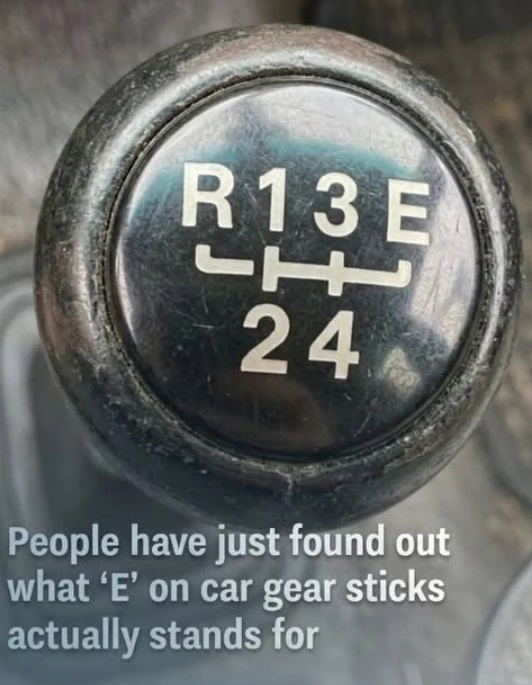
The “E” gear selector appeared primarily in American and Japanese cars during the late 1970s through the mid-1980s.
Which cars had it?
Some General Motors models (Oldsmobile, Buick, Chevrolet) with automatic overdrive transmissions
Certain Honda models (especially the Accord and Civic) with “Econ” mode
A few Ford and Chrysler vehicles
Why that era? The 1970s oil crisis (1973 and 1979) created a massive demand for fuel-efficient vehicles. Automakers scrambled to add fuel-saving features—including “Economy” mode on automatic transmissions.
Why it wasn’t standard: Not all cars had it. It was often an extra feature on higher-trim models or a brief experiment before better technology replaced it.
How “E” Mode Actually Worked (The Mechanics)
Let me explain what happened inside the transmission when you shifted to “E.”
Standard “D” (Drive) mode: The transmission shifted at preset RPM points, balancing performance and fuel economy. The engine could rev higher before shifting.
“E” (Economy) mode: The transmission shifted to a higher gear at lower RPMs. The engine didn’t work as hard. The car accelerated more slowly, but it used less fuel.
The overdrive connection: In many cars, “E” was essentially an “overdrive on” mode. Overdrive is a higher gear that reduces engine RPM at cruising speeds, saving fuel. “E” engaged overdrive earlier and more aggressively.
The “E” button: Some cars didn’t have an “E” on the gear shift—they had a separate button labeled “Econ” or “Economy” on the dashboard. Pressing it changed the transmission behavior without moving the gear selector.
Why Are Drivers Just Discovering “E” Now?
If “E” disappeared decades ago, why are people suddenly talking about it?
The used car market: As used car prices have risen, more people are buying older vehicles. A 20-something buying a 1980s classic car might encounter an “E” on the gear shift for the first time.
Social media: Photos of mysterious dashboards go viral on TikTok, Instagram, and Reddit. Someone posts a picture of an unfamiliar “E” and asks, “What does this mean?” The post gets thousands of comments, and suddenly everyone is learning about Economy mode.
Driving a parent’s or grandparent’s old car: Many of these cars have been sitting in garages for years. A new generation is inheriting them—and discovering features their grandparents never used or explained.
Nostalgia content: Car enthusiasts on YouTube are creating videos about forgotten automotive features. The “E” gear has become a popular topic.
How Is “E” Different from Modern “Eco Mode”?
Continued On Next Page
ADVERTISEMENT

